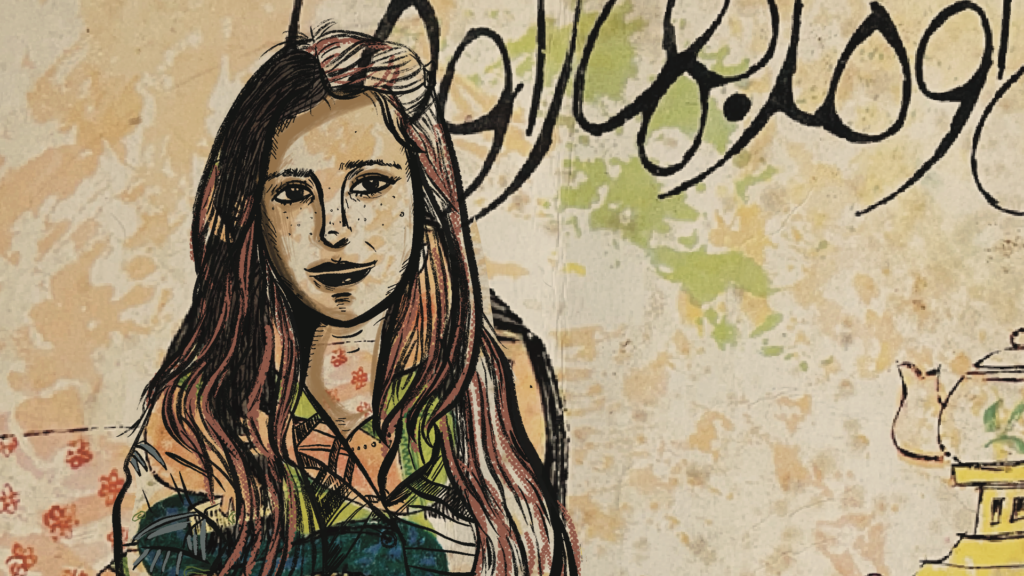
When I try to name where Ali and I fell along the racial spectrum, the word interstitial comes to mind. It was 1982 and we lived in the gaps, the only Iranians at our Southern California middle school. Iranians in Amrika were racialized before the 1978 Revolution, it was just that we were considered benign, exotic even, definitely not dangerous.
Ali’s skin was lighter than mine, with the blue-green cast of an abalone shell’s interior. His curly black hair, regal nose, and baby doll lashes might have made him attractive, but Ali’s mouth was a blunt weapon. He made the Science teacher cry. After that, I only saw him in PE.
Unlike Ali, I had no curls. My brown hair was straight, with sun-eaten tips, and fell past my shoulders. My nose was a plebian comma, and I had no lashes to speak of. I also wasn’t the one who called the white, closeted Science teacher an ass fucker in front of the whole class.
One thing that Ali and I both had going for us was the social capital of a light accent. While mine was the result of being American-born, Ali’s ability to sound the hard “w” of freeway and not turn it into the warm bumblebee buzz of a “v” meant money in Iran, before the Revolution, before the forced migration of his family: international schools and English instruction.
My family didn’t have that kind of money. Baba left Iran as a young adult in the late 1950s, the son of a civil servant. When Baba landed in Amrika, there were fewer than five-thousand Iranians who had journeyed before him. Baba took out student loans in Iran to finance his American education, money he would never pay back. It was the Shah to whom he was indebted, not the revolutionaries that overthrew him, Baba reasoned.
Baba’s father never made it to the U.S. and died before I was born. He arrived in Amrika on the tongues of his children: especially Baba, his oldest surviving son. Baba tried hard to sound like Walter Cronkite, steamrolling over consonants, but his tongue retained a languorous drawl.
There was no Saturday school for the Iranian diaspora in 1982. No Farsi classes for the American-born children. No English classes, or gossip encased in cellophane wrappers, for their parents. Tehrangeles, a cultural juggernaut that would become the American bullseye for Iranians, was a smoggy dream of a still distant future. Visibility was limited to a handful of storefronts on the Westside and in the Valley.
Elementary school hadn’t carried such tarnish. For family tree assignments, I drew the Shah’s royalist flag—emblazoned with a sun rising behind the muscular back of a swash-buckling lion—to represent Baba’s birth county. I would place it next to a sketch of my maternal ancestor, Mary Todd Lincoln.
For show-and-tell, I brought my favorite Farsi picture book. It told the story of a little girl who looked like me: flush-cheeks, almond-shell skin. She was brave and wore comfortable pants. She outsmarted a monstrous div with her intellect and still had time to drink tea dispensed from a samovar.
My pride began to sour in the fifth grade when the Iranian Revolution ignited, far from the pacific shores of Southern California. The ousted Shah fled, his role in the systemic torture and repression of political enemies haunting his escape route.
In sixth grade, the 1979 storming of the American embassy in Tehran by a group of students put Western powers on high alert. Fifty-two staff members were taken hostage; their release guaranteed only if the Shah was extradited back to Iran to stand for his crimes.
As the months of captivity ticked on, American network news kept a running tally of each one of the 444 days that the hostages were held. Nightly news updates were accompanied by grainy black-and-white images of a perpetual checkmate: one blindfolded American captive flanked on either side by young Iranians.
By eighth grade, I was numb. Baba’s growing-up stories described a country that only existed in the minds of those who had left. The swash-buckling lion was—in actuality—a cruel coward. The sun did not rise to greet him. Instead, it shrank away from his drag performance of superior strongman. I had no more comforting cultural imagery to stand upon, no foothold to steady myself.
“She begged for it,” Ali said to no one in particular.
The Roman alphabet placed me right in front of Ali, at the back of an untidy column of eighth-graders. We were lined up on the blacktop, all fifty of us, awaiting instructions from our PE teacher.
The boys within earshot leaned in. They were North Torrance diverse: Latine, East Asian, and Pacific Islander. Resplendent in OP polo shirts and dark blue corduroys, feet flashed Vans-checkerboard. We all wore street clothes for PE in 1982.
“I’m an American Gigolo,” Ali said.
There was something like pride in his voice. The boys’ collective hard focus on Ali leapt over the top of my head, neatly coiled with French braids.
Here we go again.
I caught myself from vocalizing the thought. It lay in my chest, sloshing around like a soggy bowl of cereal. I waited. The boys said nothing.
Our PE teacher didn’t hear Ali. She was three columns to the right, easy to spot in a blue windbreaker. Her back obscured by eighth-grade arms and torsos, it twitched each time she added attendance checkmarks to her clipboard.
Ali’s declaration reminded me of how unimportant I was to this scene: an extra with no lines, a girl who hadn’t cultivated the patina of middle school hotness. I slung Love’s Baby Soft and Jean Naté in long smelly arcs across my body like the best of them, glossed my lips to a wet shine, but it wasn’t enough to stack up to the swerving confidence of the popular girls, or the degrading language of a kid like Ali.
When Ali talked, I felt exposed. He called into question my already precarious understanding of what it meant to belong. No one seemed to remember that I was Iranian too. I was hiding behind my vowel-laden name, merging with a sea of other vowel-laden names. I was hiding my attraction to other girls through loud and public swooning over the latest Teen Beat pinup of Scott Baio.
Ali smiled and folded his arms across his chest, waiting for a response.
The boys squinted. It was hard to tell whether the narrowed eyes were the result of suspicion, or an attempt to reduce the sun’s glare.
As I watched Ali’s eyes skitter back and forth, taking in his audience, something spiny blossomed in my chest. It wasn’t just the way I felt, standing next to him on the blacktop. It was more than that. He wore Iran, a translucent home I had never traveled to, like a mantle of shame. Ali was a refugee whose family had recently fled. He wasn’t what I imagined a kid my age from Tehran would sound like.
I wished he would disappear.
If Ali wasn’t in the picture, I reasoned, I could continue to blend in quietly as a resident of North Torrance. While South Torrance was hilly, white and windswept, with big homes and sprawling church complexes that offered views of the Pacific, North Torrance was flat, Brown and gray: pebbled with oil refineries, high voltage power lines, and tired stucco apartments.
“She begged for it,” Ali repeated.
He said it a little louder this time.
Ali’s hand slid down the front of his jeans, settling onto his crotch with a practiced tug.
“I was standing at the open door, holding a pizza box, and she went down on her knees,” Ali said.
Gross.
Our PE teacher was now a speck against the bright morning, five columns down, as far as she could be while still holding some semblance of authority over us. The cars along Artesia Boulevard hummed as they ran parallel to the school’s chain link fence. They created an ambient soundtrack to Ali’s potty mouth.
“Bullshit,” said one of the boys.
It broke the shell of quiet.
The other boys began to laugh and whoop.
“No, it’s true,” Ali said. “She blew me. And I still made her pay for the pizza.”
“You are so gay, Ali. You don’t know shit,” said another one of the boys.
The slur found an unexpected home in my throat. It squeezed tight and began to tickle, threatening a cough. At recess, I had been staring, a little too long and ardently, at girl-asses poured into Ditto, Chemin de Fer and Jordache Jeans. But I wasn’t the one under surveillance, I reassured myself.
They don’t see me. Right?
Before that squeeze, I hadn’t thought much about the Ali who existed outside of middle school. Watching Ali grab his dick on the blacktop made me wonder about his family. Something about the performativity of the action, the desperation even, conjured the spectre of a ghostly Mamani shaking her head, disappointment painting her face.
The PE teacher blew her whistle, drowning out the exchange between Ali and the boys. Her frame diminished by the distance, I saw her arms sketch parabolas in the air, like ground support directing aircraft on a tarmac. It was a command for us to move onto the scrubby field. The lines broke as we followed her, fished Velcro belts fluttering with bright strips of color out of cardboard boxes in preparation for a flag football game.
Two years before, the hostage negotiations had stalled. President Carter—in the midst of 1980’s election year—launched Operation Eagle Claw to rescue the fifty-two Americans. Eight Delta Force helicopters were deployed for the mission. It was an ill-fated attempt that didn’t even get close to Tehran. Three helicopters were rendered inoperable. One helicopter crashed. Eight American servicemen were killed. Post-debacle, Ronald Reagan’s campaign manager conspired to delay a hostage release until Reagan was elected the 40th President of the United States.
In a damning non-coincidence, the hostages were released on January 20, 1981—Inauguration Day.
The Shah was never extradited to Iran.
A full year after Inauguration Day, and only days after the pizza delivery story, I was back on the blacktop. I noted a few gaps in the columns: absent or in-trouble students. We still represented a small forest, or—maybe the right word was a grove? We were close to the number of American hostages, now freed and back on American soil, a grove of trees wrapped in flesh. I followed the cues of the students in front of me who mirrored, and refracted, the PE teacher. I couldn’t see her, but I could hear her. She called out numbers in staccato, counting off a series of jumping jacks.
I was in my designated Roman-alphabetical spot, a few feet in front of Ali. Without warning—four boys lunged in Ali’s direction. Their movement caused the air around me to displace, a sharp caress. These were the same boys who listened so carefully to Ali’s fake blow job chronicles. It was a coordinated attack.
Huffs of “Iranian faggot!” accompanied hollow thuds to Ali’s head and chest.
I stopped jumping.
Ali fell to the ground. Another boy’s foot connected with Ali’s back.
I didn’t speak, or couldn’t find the words.
Ali rebounded to his feet, his hands braced against his sides.
My eyes flicked and I stared at his hands: they closed into fists and released in a patterned rhythm, like the gills of a fish out of water.
Had I been found out, simply by being in proximity to Ali?
Hate was contagious. I was terrified on my own behalf. Some of the boys might vaguely remember my elementary school family trees. Plus, there were my errant eyes tracing back pocket arabesques of stitching on denim during recess.
Had one of the boys spied my lingering lesbo glances? Would they attack me next?
The boys didn’t come after me. No other student responded to the attack. A few did glance back, then quickly swiveled forward again. The rest continued to follow the PE teacher’s cues without wavering. When the class switched to high knees, the boys slipped back into their assigned spots. I glimpsed the PE teacher’s blue windbreaker behind a wall of bouncing heads, at the base of the fifth column.
I kept still. Ali remained standing, his face cast downward. When it was clear that the boys were done, that I wasn’t their next target, I surprised myself by taking a step towards Ali.
I broke away from the column. For the first time, I was close enough to see the delicate folds at the outer corners of his eyes.
“Are you okay?” I said.
I had never intentionally spoken to Ali before.
He didn’t meet my gaze. I heard the PE teacher call for push-ups. Blasts from her whistle prompted bodies to shift in my peripheral vision. I stepped back to regard Ali. He had a scrape on his cheek and was rubbing the back of his head.
“I’m Iranian too,” I said.
Ali’s jaw squirmed beneath his skin and he raised his eyes to meet mine. I wanted to sob at the contact, but my throat remained tangled, a damp knot. His gaze yanked me by the waist, disrupted my balance, jostled my feet off the blacktop. At least, that’s how it felt, for the briefest of moments. Like I was falling and would never hit the ground. When I finally blinked, my eyelids remembering how to flap, Ali had already looked away.
Soon after I witnessed the assault on Ali, the PE teacher asked me to stay behind at the end of class. Mrs. Yamato was only a few inches taller than me, with massive calves and gingerbread skin.
“Eh. Elahi. Stay back.”
Why did she want to talk to me? I wasn’t a tattletale.
“Your dad is Hawaiian. No?” she said.
I stared at her. This was not the direction in which I thought the conversation was headed.
“Um,” I said.
“Your dad plays on one of the softball teams? Has the same last name as you?” she said.
I willed my head to bob up and down in wobbly agreement.
“I met him,” she said. “He’s a good pitcher.”
She cracked open a door. No more fear of being outed as a lesbian butt-loving hostage-taking Iranian. She didn’t know about my lingering glances. In her eyes, I was hapa: half white, half Hawaiian. It wasn’t a stretch. My aforementioned vowel-laden name. My hazel eyes.
North Torrance, like other inland cities in the South Bay, was a center for the mainland Hawaiian community. There were plenty of hapa kids in middle school. Many of the teachers—and parents of my friends—belonged to the local Hawaiian softball league. Why not Baba?
I shoved my proverbial foot into that door’s gap and met Mrs. Yamato’s gaze.
“Yeah,” I said. “He plays all the time.”
She smiled. “I knew it,” she said. “Hurry up, then. Don’t be late to your next class.”
I walked along, buoyed. Hyphenated Baba was now a mythical jock: his body cloaked in American athleticism. Even though Baba didn’t know the first thing about softball and preferred long hikes on Mount Baldy. Even though the PE teacher didn’t get it right. She thought we fit. At that moment, just thinking was enough.
The attack on Ali continued to haunt me. I remember a strange cocktail: aversion and shame, horror at the violence directed at Ali, deep sadness at his refusal to make common cause. He didn’t have the luxury of ambiguity, of presenting as anything other than a racial outsider. Ali, with his almost-American accent, was stuck, tangled into a historical web that I was able to side step with a softball tale.
The emotional state that emboldened my whispered confidence was a tick of solidarity, a momentary stand against fear. It wasn’t courage that prompted me. It was a sick awareness.
My confession was weak. I could hide. He was exposed. I could not protect him, even if I knew how.
Since 1982, my ability to conceal and my desire to reveal has continued to mutate, sometimes by design and sometimes because of systems larger than myself. As a result, I have been all the racialized things: ignored and targeted, assaulted and sniffed at, rejected and listened to, ridiculed and embraced. What remains is my ability to choose when and how to declare a racialized self, at least on the physical plane. How—and what—will I reveal? When—and if—I do, will I be seen as I see myself ? My face precedes me, a rude dinner guest who keeps interrupting the conversation.
What can you say to a face?
Recently, I was able to track Ali down on social media. He looks the same: regal nose and baby doll lashes. He looks different: laugh lines around the eyes and gray sneaking into the hair line. He still lives in the South Bay. He’s single and has a younger sister. I wonder if he’s an uncle now, a dâyî to any nieces or nephews.
I sent a friend request months ago.
I imagine another moment on the blacktop, so close to Ali that I see the pores constellate his waxy skin.
Instead of looking away, Ali closes the gap between us, our shoe tips touching. Or—if his gaze is still averted: I softly call his name and his attention returns. Then, I close the gap between us, our shoe tips touching.
Either way, I embrace him and he responds by pressing his face into my shoulder. I stain his Members Only jacket with tears and snot. He paints my unicorn-print blouse with subvocal sobs. It’s a brief exchange and wordless. We don’t become friends, exactly, but—when we line up for PE the next day—we start nodding to each other, occasionally exchanging greetings in Farsi. He calls me bacheh naneh and chuckles, his eyes alight. I get to laugh at his non-obscene jokes.
Ali is a vivid storyteller, after all.