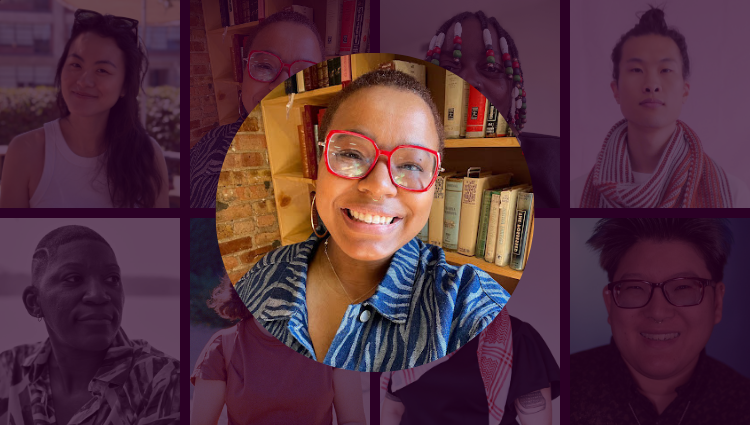
Alina Moore was one of our Spring 2025 Digital Residents. As a part of this program, we do Q&As with our residents to feature them, their work, and their words. See our Q&A with Alina below, and explore more Spotlights here.
TSW: Tell us about your work, writing, or project. What are you writing these days? How is your work changing, and how is it changing you?
Alina Moore: Most of my work centers the BIPOC identity, the (L)GBT community and feminist thought. I am currently working on two projects; a poetry collection focused on my self identity/discovery as a black lesbian woman living and learning in a patriarchal society. I am also working on my first novel about black lesbian women in the 1970s disco era. The story centers conversations around black queer artists that have big aspirational creative dreams as artists, their fight to have an impact in America’s cultural and political threads and how many are forgotten by history or erased for political/racial agendas.
TSW: What is a question you’re asking yourself these days, and what is a question you or your work is asking of your reader?
AM: Questions I have been asking myself in terms of my work and the questions I seek to ask my readers is, who’s voice do you hear when you speak, who’s words come out of your mouth? Is it yours? Is it others? Do you silence that voice? Do you share this voice? Can this voice change or evolve?
TSW: Who do you bring into the room with you when you write, and/or, who do you consider your work to be in conversation with? Who are you writing for?
AM: In a literal sense, my dogs are my shadows, they are my comfort and they are always the ones that hear the stories first. In a more conceptual sense, the person in the room with me, and whom I am in constant conversation with are my inner voice and most time those are my ancestors, those that are familial, those that are not. I listen to their voices and how they move my body to write and encourage my voice to write out what they wish to share. I am constantly asking questions on how I am able to bring voices from the past into the present to be a reminder and to become a statement.
TSW: What were you processing during our residency program? Did anything unlock for you? If so, what new entrance did you find for your work or for yourself as a writer in the world? And what caused that shift?
AM: This was my first residency experience and I had no specific plan in terms of how I wanted to enter and approach the program. Because the program was focused on entering specific aspects of craft as a writer, creative, or thinker, I realized my approach to my work was to strip back the inner critical voice and become one with the inner creative voice and to follow any little pieces that are speaking through me and bring it to the page.
TSW: What’s a mantra or motto that you have in mind these days when you are writing or creating? Is there a writing routine or ritual that keeps you beginning?
AM: A well-known quote by a writer, activist and woman that inspires me everyday in my life, in my personal growth and the vision I have for my writing and my community,
“I was going to die, sooner or later, whether or not I had even spoken to myself. My silences had not protected me. Your silences will not protect you… speaking will get easier and easier. And you will find you have fallen in love with your own vision, which you may never have realized you had… You’ll know with surpassing certainty that only one thing is more frightening than speaking your truth. And that is not speaking.”
– Audre Lorde’s essay in “Sister Outsiders: Essays and Speeches”
I approach the page every time knowing I choose to speak, I choose to share my truth, and there is always space, time, and an audience that are seeking and needing voices like mine.
TSW: What motivates you to keep beginning, and/or, what is a story that gave you permission to tell yours?
AM: A book I read recently that led into my time with the residency program was The Year of Yes by Shonda Rhimes. In this memoir, Shonda Rhimes, this Chicago-born, black woman, producer, screenwriter, and founder of the production company Shondaland, having the success that can rival any story creator, commits to a year of saying Yes to any opportunity that comes her way after feeling stuck and lost, hiding from the world and hiding from herself even during her success and fame from shows like Grey’s Anatomy and Private Practice and many successful screenplays.
Someone as successful as Shonda Rhimes expresses how saying Yes to herself for a year, her abilities outside of her creative skills, and taking a chance at something new that could allow her to grow as an individual, allowed for growth, confidence and strength within her inner voice and as a creative. This book gave me the motivation to fully say Yes to myself as a creative, to be unafraid of being seen trying, of beginning again and learning through the failures.
TSW: What is something that someone said — a fellow resident, a past mentor, perhaps something from one of the bonus sessions — that helped change the way you see your writing or work?
AM: During one of the celebratory showcases, a fellow resident said “A story, after all, is a kind of swallowing.” And I feel this made me reflective on what is being consumed from my work, or rather what I want to be consumed via my writing. I feel like after this residency I am able to approach the page with more intention than before, I feel I approach the page with the motivation to have my stories and words swallowed wholly and fill each reader with the same motivation to share their own.