Editors’ Note
When we began the process of bringing this anthology together, we hoped it might return us to a practice of making language alive between us. Language as a crucible for connection; language as a weapon against the death-seeking repetitions of colonialism and Western liberalism. Our provocation, to ourselves and to our contributors: to what extent can language, wielded by those who refuse the logics of extraction and genocide, actually prefigure freedom?
As we write this note in January 2026, the answer to that question seems to be a resounding “not very much.” Israel violates the so-called “ceasefire” agreement continually and countlessly, across Gaza, the West Bank, and Lebanon. UAE-backed RSF massacres in Sudan’s Darfur region have martyred so many people that bloodstains became visible from space. Here in Toronto, cultural institutions double down on censorship and bullheaded antagonism, sanctioning artists, curators, and board members who dare to protest connections to Zionist war profiteers. Our community members struggle to hold onto hard-won, life-saving concessions: safe consumption sites, stalled deportations, the barest semblance of COVID protocols in public space.
How do we make sense of these, the long timescales of genocide and spiritual crisis, alongside transient cycles of uprising, organizing, absorption, state repression? How do we acknowledge stuckness without succumbing to inertia? How do we discern the gradations between rehearsal and deferral?
The pieces collected here offer not answers, but forms of attention.
August Chun and Claudia Owusu’s gatherings of word and image catch and snag on the fabric of the world, illuminating “loopholes of retreat” from which to resist the totality of the state’s repetitions. Gunjan’s adversarial poetics “echolocate the walls of the enclosure,” rendering hope unintelligible to the technofascist corporations that control our mechanisms of connection and meaning-making. Amy Ching-Yan Lam’s archival sleight skewers liberal anti-Communist ideologies to examine the daily structures of feeling and thought that shape our art practices.
In the article, “In tune with their time,” Nasser Abourahme frames the genocidal present as Zionism’s endgame: a foundational impasse in which Israel’s drive toward annihilation is blocked by the Palestinian people’s insistence on life, by armed resistance within Palestine, and by movements for Black and Indigenous liberation globally. The works collected here attend to moments of impasse and frustration, exit and freedom, that mark colonial endgames, and to the ordinary rhythms of habitable life that propel the long arcs of anti-colonial struggle.
Jane Shi’s poems accumulate visual and sonic repetitions as a strategy of collective sustenance in the face of the Imperial Japanese Army’s brutal wartime eugenics. Fan Wu’s piece interiorizes the frustration–freedom dialectic, turning to psychoanalysis and Daoist-Buddhist cosmologies to dissolve the boundaries between self and system. Bahar Orang’s poems and Connie Li’s sonic and lyric containers keep time with the pulse of habitable life, sustaining “a gap mechanism that resembles freedom,” a waking beyond waiting.
Against the crushing timescale of manufactured death, the artists and writers gathered here insist on a different measure. We return, in reflection and recursion, to Bedour Alagraa, whose language kindled this anthology: “Against the assumed unbreakability of the interminable, the meter breaks.”
Table of Contents
What’s inside “On Repetition”? Editors-in-Chief Jody Chan and Noa Sun describe each piece that is in their anthology.
Amy’s loyalty oath for artists reconstitutes archival records of the Congress for Cultural Freedom, a Cold War era CIA-funded anti-Communist organization, into a contemporary indictment of liberal ideologies and their insidious absorption into the business and practice of art-making.
August’s photo essay turns language and image into a weapon against deportation, gentrification, and pandemic abandonment, countering isolation with the insurrectionary rhythms of love and care in their beloved Bay Area and Los Angeles communities.
Bahar’s poems stage a communion between the living and the dead, wielding the intimate silence of lyric to attune to the chorus of history, grief, love, and violence.
Claudia’s vignettes render the contours of Black girlhood in prose and image, mapping how the body breaks, betrays, loves, and heals itself again and again, alone and in community.
Connie’s poems and audio pieces harmonize with repertoires of care and longing, both musical and medicinal; the grieving body’s cycles and improvisations, its disjointed yet graceful movements through time.
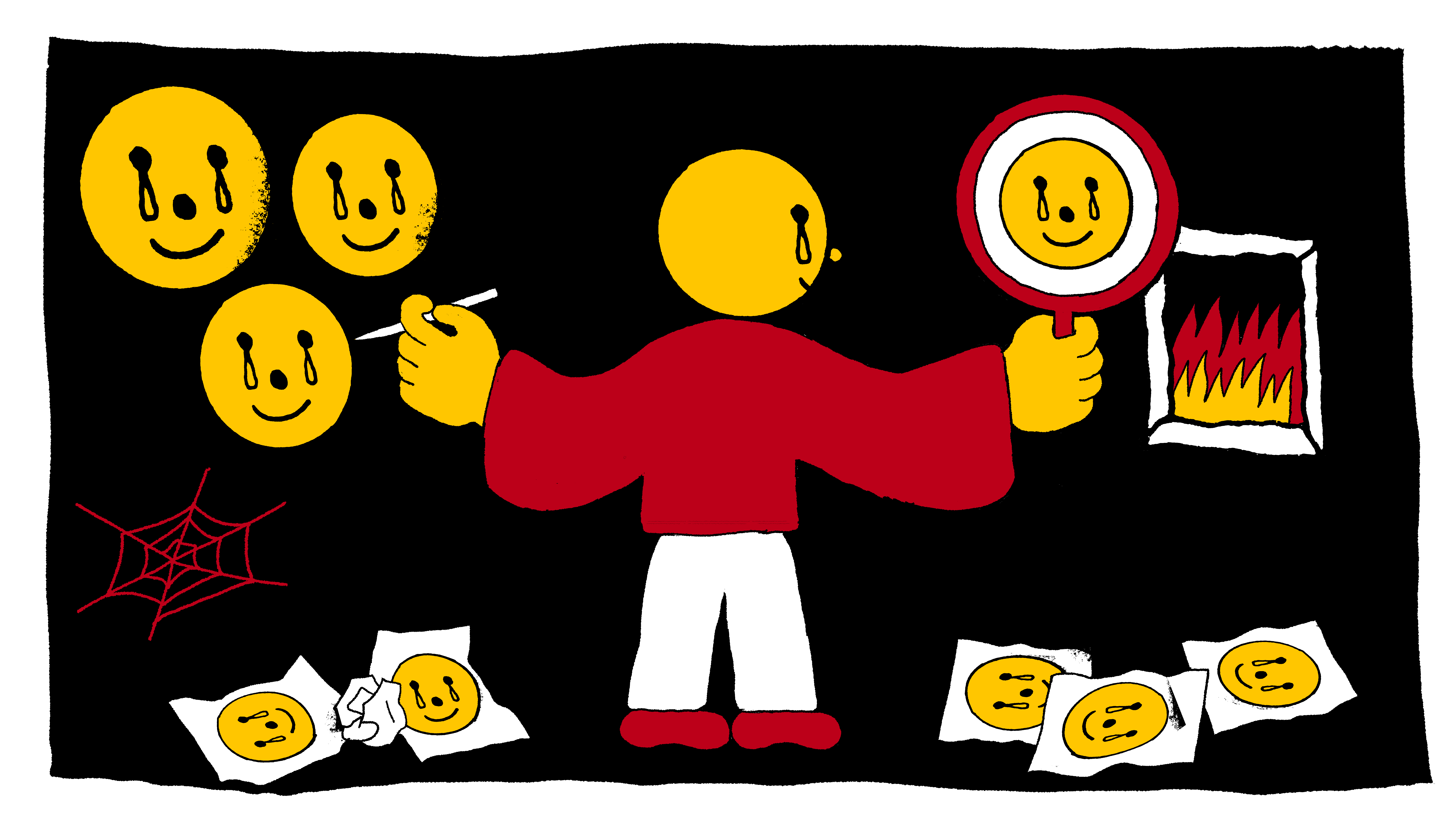
Fan’s essay in fragments stirs the soup of obsessions come and gone and come again, interrupting long-held habits and compulsions to ask: “How do we break free of the repetitions that have claimed us since childhood?”
Gunjan’s adversarial poetics experiment with breaking the meter of big data, forging a grammar that is unintelligible to artificial intelligence and the mega-enclosure of Platforms.
Jane’s poetry retools the recursive rhythms of empire, suturing the history of Japan’s Unit 731 to contemporary eugenics through the haunting lyricality of nursery rhymes
Close"On Repetition" original call for submissions
This is the call for submissions, which is what the published contributors submitted work toward:

Sometimes, repetition is stuckness — a growing internal tension, rotation on a fixed point, a deferral of what is needed to break free, a returning over and over to what we already know doesn’t work. But repetition can also be a form of rehearsal, or even a propulsion — towards freedom, towards living, towards what Fred Moten and Stefano Harney refer to as the “wild beyond.”
This anthology is interested in repetition as generative and destructive; as a creative device and a constraining force. Black studies scholar Bedour Alagraa defines catastrophe as a repetition of the originary events of colonialism and slavery. But this piling up of crisis is also defined by its vulnerability to interruption. In Alagraa’s words, “Against the breathless numbers, the cruel mathematics, and the assumed unbreakability of the interminable, the meter breaks.”
There are, and always have been, openings that break the meter of colonialism and Western liberalism. From boycotts and blockades to stopping arrests and deportations, organized people attempt over and over to interrupt every kind of abandonment, every kind of enclosure. How can language prefigure new rhythms and expressions of freedom, new openings for action — and widen existing ones?
This anthology invites experiments with form, genre, and medium; pieces that both practice and study repetition. What effects can be generated from the doing of language — its ritual, its collective choreography, its movement through our minds, bodies, and political practices? What lies within and beyond repetition?
Close