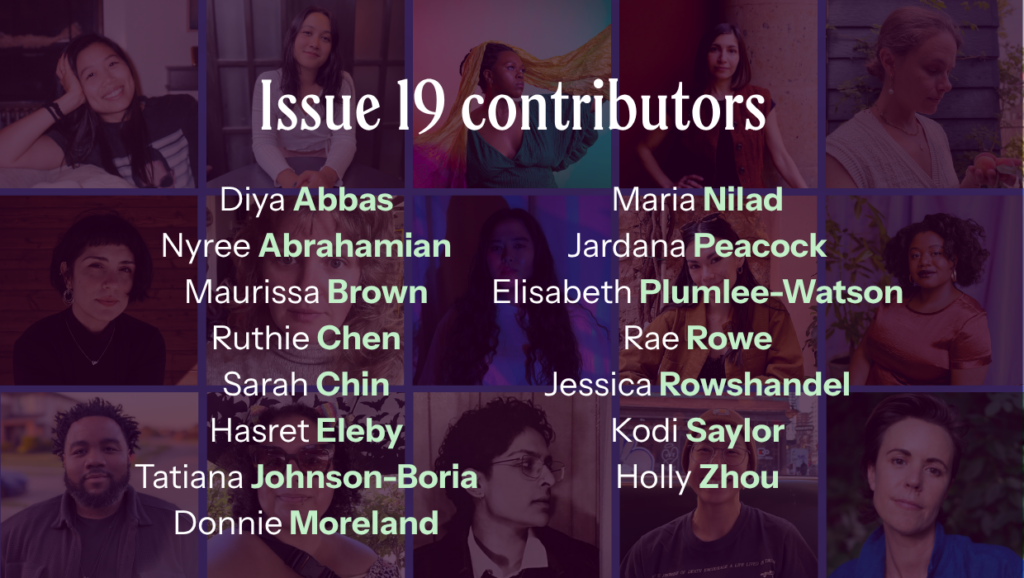
Editorial Note: In June 2026, we will publish Issue 19: Little Changes, and within it, the work of these 15 incredible writers, poets, and artists. Below, you’ll find some words from each of the contributors about how they’re approaching the topic, and get a little peek into these brilliant minds. We’re so thrilled to welcome them all into the Wavey fam.
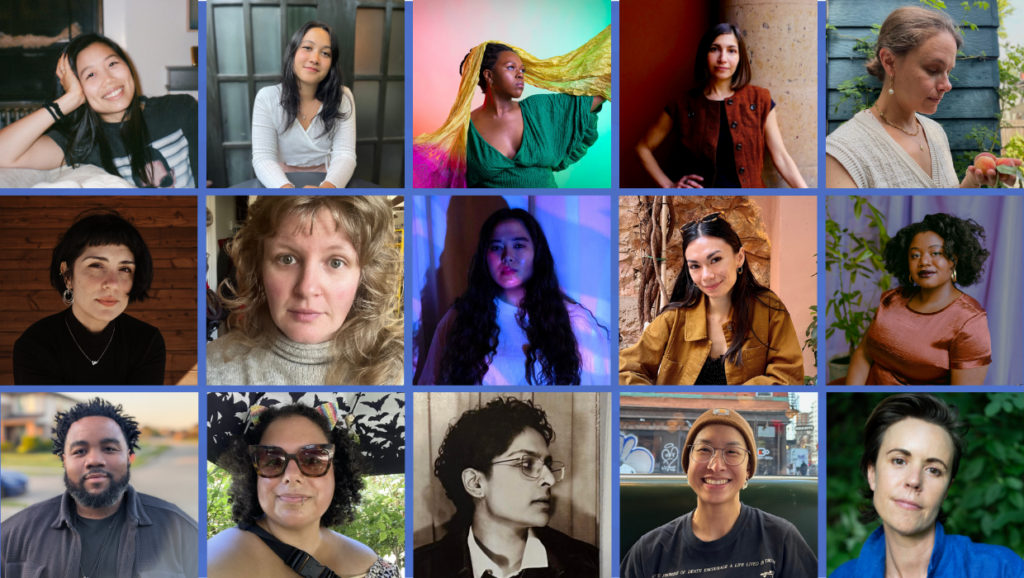
Middle row: Hasret Eleby, Kodi Saylor, Rae Rowe, Sarah Chin, Tatiana Johnson-Boria.
Bottom row: Donnie Moreland, Jessica Rowshandel, Diya Abbas, Holly Zhou, Jardana Peacock.
“Just as music gets sampled and remixed indefinitely, I’m interested in poems that inhabit multiple lives over time. I tend to write poems in pairs, which is to say, I write three poems: two standalones, plus the third thing that emerges when you consider them side-by-side.”
— Ruthie Chen
“As a young woman from the Philippines, engaging in activism and worrying about the future under climate crisis, I write between scales: the personal, the environmental, the political.”
— Maria Nilad
“I am driven to action by the environmental justice movement and the ambiguous grief that accompanies the loss of a healthy planet-home, loss of place and future.”
— Maurissa Brown
“I turn to poetry because at times, it feels like the only way to face the unknown — not for answers, but to deepen my curiosity and wonder. Through poetry, I’m able to explore nuance, and hold grief and hope with equal reverence.”
— Nyree Abrahamian
“I rejoice for the joy of queer parenthood and partnership; I worry about what creative modes of care less similar to heteronormative family structures are being lost. … [My essay] is about the model of care that has most formed my life since early childhood and which often feels so lacking from white Capitalist America: elder care, especially beyond genetic bounds.”
— Elisabeth Plumlee-Watson
“Queer Muslim lives have never been visible enough to even warrant mainstream debate or legislative attention in the communities I come from. We exist in the margins of margins, erased from queer narratives that center whiteness, erased from Muslim communities that deny our existence, erased from immigrant stories that only make room for heteronormative struggle.”
— Hasret Eleby
“The driving force behind these poems is desire to document and make sense of the work I undertake everyday weaving myself into the systems I encounter and to imagine a path towards liberation from exploitative labor and knowledge systems.”
— Kodi Saylor
“By trans-ing and queering my origin stories, I am able to show new futures with a past that can better align with identity. Through this action I am able to show that queer and trans ancestors exist. I am able to show that queer and trans people will always exist.”
— Rae Rowe
“I’ve been thinking a lot about how we carry large-scale crises in our bodies long after the headlines move on. This piece is the product of that tension: the dissonance and interplay between the vast (the ocean, wildfire, empire) and the miniscule (a thimble, a needle, an apple held in a child’s hand).”
— Sarah Chin
“My essay is really about approaches to parenting (culturally and societally) and also the history of oppression of children, which I believe is often overlooked in larger conversations about marginalization. bell hooks spoke about this in much of her work and was an immense advocate for children’s rights. She believed that in order to change society, we must change how we treat children.”
— Tatiana Johnson-Boria
“I like to believe my art carries two responsibilities: to encourage readers to write and to inspire a persistent desire for research. I see myself as an attendant of the archive, and I believe creative writing can fill in the gaps — making the act of inquiry, in a way, irresistible.”
— Donnie Moreland
“I am a kind, tender person who is often pissed off. I have a sweet face and a sweet speaking voice so people don’t expect disruption from me. But I am the person to walk into a fucked up situation and say the quiet parts out loud. I am really good at that, and my writing reflects that.”
— Jessica Rowshandel
“I wish these poems to be works of language that are willing to face the Truth, that force us to face our own complicity, our relationship with language and the page, and call us to pull our Beloveds even closer, those here and gone.”
— Diya Abbas
“I’m interested in omission, what the state prevents us from saying and how we can turn that silence back onto the state as subversion.”
— Holly Zhou
“My work integrates magical realism and searches for beauty and resilience inside of the violence of our history and human experience. Art connects me to a deep knowing: when harnessed, our imaginations have the power to heal and change injustices.”
— Jardana Peacock
Please join us in welcoming these 15 voices into the Seventh Wave fam, and be on the lookout for their incredible work in The Magazine come June 2026!