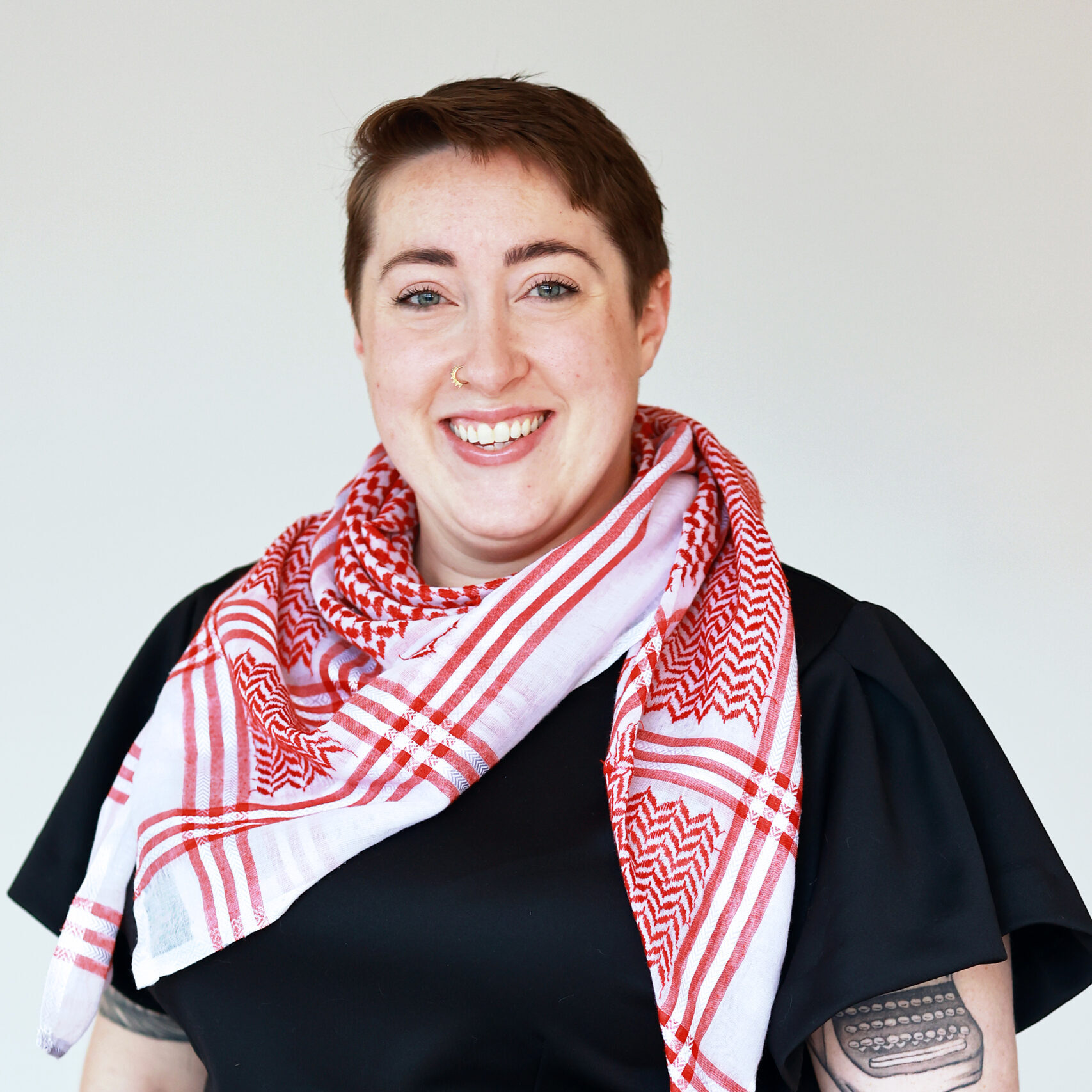

Mandy Shunnarah was one of our Spring 2025 Digital Residents. As a part of this program, we do Q&As with our residents to feature them, their work, and their words. See our Q&A with Mandy below, and explore more Spotlights here.
TSW: Tell us about your work, writing, or project. What are you writing these days? How is your work changing, and how is it changing you?
Mandy Shunnarah: I’m a poet, creative nonfiction writer, and weaver, and I’m currently exploring ways to blend my chosen writing genres with my fiber art practice. I’m diving into weaving as a vehicle for storytelling beyond the obvious metaphor of blended narratives and seeing how the tactile act of weaving can be portrayed on the page through poetry, as well as what the natural integration of weaving as an embodied art can teach me about the craft of writing.
Maybe the plot is not linear as in left-to-right, but right-to-left and even up and down with concurrent narratives layered on top of one another to form a cohesive whole. I’m considering how, even in a single paragraph or prose poem, I can use indicators like underlined, bold, italicized, or colorful text as “stitch markers” to convey these multilayered narratives in a single piece — like an erasure poem where the erased text is grayed out or struck through but is still visible, or how contrapuntal poems give a piece multiple interpretations. I’m interested in how paragraphs or even a single sentence can be repeated but change, shift, and progress to form new meanings as it is constructed or deconstructed down the page, like the endless under-over-under-over layering of weaving and Mag Gabbert’s breakup poem form. I’m interested in form in general — both how I can challenge myself to adhere to it, how I can bend or break it in interesting ways, and how I can create my own poetic forms.
Because I’ve only been weaving for a little over a year, I still struggle to call myself a visual artist, so the idea of the page as a canvas has never quite resonated with me, mainly because I don’t know where to begin. However, nearly all weavings begin the same way: The weaver must first put the warp string on the loom. If the loom is a square or rectangle, the warping starts at the bottom, and from there, I can choose to start at the bottom and add layers of tapestry yarn, or I can outline a shape in the middle, or start at the top and weave my way down (though that’s less conventional). If the loom is a circle, I know I’ll begin weaving from the center and work my way outward either in a spiral or as haphazard slices of pie, weaving one “piece” at a time.
Even though the concept of the page as canvas and the page as loom might be similar, to my brain, the loom provides just enough structure to allow me to experiment creatively without feeling overwhelmed. I’ve been working to replicate that feeling on the page. Some days I decide on the form the writing will adhere to and begin there, but over time, I deviate from that form to achieve a more memorable and resonant effect. This might happen within a single piece or over the course of a longer project like a zine, chapbook, or full-length book.
TSW: What is a question you’re asking yourself these days, and what is a question you or your work is asking of your reader?
MS: Lately, I’ve been asking myself about the role of the diasporic writer and the ethics of diasporic writing. Since I’m Palestinian and have always lived in the U.S., the last thing I want to do is imply that my lived experience is representative of all Palestinians or that people should read my work instead of the Palestinian writers who grew up in the homeland or who live in the homeland now. Yet in the U.S., it’s so often diasporic writers who are given the mic and publishing opportunities simply by nature of being here instead of “over there.”
Therefore, as a diasporic writer, it’s my duty to uplift the voices of Palestinians in the homeland, especially those who have suffered directly under the genocide that has been ongoing since 1948. I don’t want readers to read my work in place of writers like Hiba Abu Nada, Refaat Alareer, Mosab Abu Toha, Tariq Luthun, Yahya Ashour, and others, but in addition to these writers — the former two of whom were murdered in this most recent and violent wave of the genocide, and the latter three of whom are now living in the U.S. due to Zionist-imposed exile. It is also my duty to uplift the voices of other Palestinians on the ground who may not consider themselves writers, or who perhaps didn’t write often or at all before October 2023, but who have nonetheless been documenting their experiences in words and other expressions.
Recently, there has been discourse in the literary world that equates diasporic writing to being too sincere, bordering on smarmy, and lacking in insight, and suggests that diasporic writers are overstepping and capitulating to the white Western gaze. While this argument certainly has its merits, I think there’s more nuance that needs to be explored. Few diasporic writers actually chose to be in diaspora, separated from their familial ties and ancestral roots. Those of us living in the Western world are forced to contend with a publishing industry controlled by those with Western tastes and interests, so we must navigate how we can advocate for our homelands using the gifts and talents we were naturally afforded in a way that gatekeepers — be they publishing houses, social media algorithms or others — and readers around us will listen to at all. With Palestine in particular, there are as many, if not more, of us in the diaspora than in the homeland, precisely because of the violent Zionist colonial project that is Israel. We long to be in the homeland, even as our friends, family, and community are suffering, yet we cannot — not because we don’t want the homeland badly enough but because the Zionist entity will not allow us to return.
While some diasporic writers may be able to now return to their homelands permanently or at least for a visit if they so choose, Palestinians cannot. There are countless stories of Palestinians in the global diaspora and those who are displaced within historic Palestine who have tried to return and are prevented from doing so under threat of violence, including death. Therefore, the idea that diasporic writers shouldn’t speak out at all, especially in a way that utilizes our blended identities to advocate for our people’s fundamental human rights, is absurd. The idea that diasporic writers are fraudulent is nothing short of erasure — a denial of the lived experiences of millions of people around the world, framed as myopic willful ignorance of the ways in which we have been robbed of our birthrights, often by the very countries we find ourselves living in.
Diasporic writers must use our privilege for good, especially the privileges we did not ask for but are nonetheless afforded by the nature of being in diaspora in the West. We must advocate and work for a free Palestine, free Congo, free Sudan, free Pakistan, free New Caledonia, free Haiti, free Hawaii, and more, with our whole chests at every opportunity. The unfortunate truth is that there will always be people (mostly white, but not always) who prioritize the voices of those most legible to them, which means those of us in diaspora must not only educate readers in the West about our homeland and its plight, but also point them toward the writers in our community who most deserve to be heard. Not because these writers cannot speak for themselves, but because they deserve to be listened to by all, including those who may not yet know about their work or who lack the background, context, and knowledge to understand the full implication of their words.
It’s easy to forget how propagandized education is in the West because no one wants to admit a multitude of ignorance after 12+ years of learning, even in highly ranked schools and so-called elite institutions. It’s easy to forget that the knowledge that so many writers in their homelands are born into must be learned by those outside of it, not necessarily because Western people don’t care or aren’t curious, but because they don’t know what they don’t know. My goal is not to defend willful ignorance, which is repugnant, but to encourage and empower those who are willing to learn and join the fight for our causes to do so.
While no writer with a marginalized identity should be forced to make themselves legible to those who do not share that identity, diasporic writers have an essential role in the literary landscape by helping point good-faith readers in the right direction. I cannot consider myself successful as a diasporic Palestinian writer if someone reads my work and stops there. My goal is that even if someone starts caring about Palestine because they read my work, they will continue their self-education by reading more Palestinians, including the vital words of Palestinians most directly impacted by the U.S.-funded and Zionist-implemented genocide.
This plays out in my work in several ways. Because diasporic writers are adding to, not starting, a conversation about our homelands, I include epigraphs from Palestinian writers past and present, in the homeland and in exile, to give credit to those who gave us this literary lineage, as well as contemporary Palestinian writers actively contributing to it. The desire to credit those who most deserve our attention is also why I insisted on adding an introduction to my debut poetry collection, We Had Mansions, even though that’s not common for the genre. Having that introduction gave me the space to shout out writers from Gaza and state the perspective from which I’m writing, so it’s clear that I’m only speaking to my experiences as a Palestinian in diaspora, not Palestinians as a whole. With millions of us in exile and generations of Palestinians around the world, our lived experiences differ wildly, but what connects us is our yearning for a free Palestine. Other ways I advocate for our people and share other Palestinian writers’ work are through bookstagramming, giving verbal shout-outs at readings, fundraising for Palestinian mutual aid, and educating allies about BDS.
One of the critiques about diasporic writing as a whole is that writers tend to portray their homelands as being in need of saving, which reeks of the Western white savior complex. This, again, is complicated by Palestine since I would argue that anyone who is being subjected to genocide needs support, including aid resources and firepower to resist the violent occupation forced upon them. The approach should not be white saviorism, but empowering the people who are already on the ground, including the resistance fighters, to better save and defend themselves. I want to be abundantly clear: Every need Palestine has is manufactured by Zionists and abetted by the West. Gaza isn’t suffering a natural famine — Gaza is being starved by Zionists. Gazans aren’t simply dying — they are being murdered through airstrikes, bombings, snipers, and the manmade conditions of starvation directly caused by Israel.
Yet this leads to another critique of diasporic writing: That writers in diaspora who don’t paint their homelands as being in desperate need of saving render them on the page as idyllic edens of leftism before colonization. I find this too far a swing in the other direction because it’s an infantilizing and ahistorical belief that upholds the problematic perfect victim narrative. Every society has its problems, regardless of whether its people have been colonized. Colonization only amplifies existing societal issues, adds its own plethora of nefarious villainy, and multiplies both ad infinitum.
Diasporic writers then find ourselves in a difficult bind: We’re expected to render our homelands as well as those who were born there, despite being denied access. We’re expected to use our privileges living in the seat of empire to advocate for our people, to draw allies in, but not make them too comfortable. We’re expected to educate and inform, but not do so to the point that those who don’t share our identity become our primary readership—otherwise, we’re assimilated sellouts. And if we write about these complexities of our existence, we’re accused of being whiny and smarmy, filtering the story of our lives through the only lens that the primarily non-diasporic professionals in the publishing industry are seemingly interested in hearing.
Many of the critiques of diasporic writing take issue with the writer daring to write about themselves at all, as opposed to only focusing on the larger systems of injustice of which they are an arm’s length removed. These criticisms essentially boil down to the notion that some diasporic writers can see and articulate complexity within themselves, yet sometimes fail to apply that same curiosity to the homeland itself. Of course, diasporic writers should speak truth to power, especially when that means thoroughly researching that which we cannot access directly. However, to imply that diasporic writers have no place in the literary landscape, or that we shouldn’t speak to our experiences at all, is another form of colonial theft, even when it is practiced by colonized peoples, including those who share our identities. The theft of the few dregs we have of what has already been so thoroughly denied us is yet another manifestation of the perfect victim narrative. If diasporic writers don’t adhere to the stereotypes placed on us by those outside of our communities and don’t follow the strict expectations sometimes placed upon us by our own people, then we’re led to believe something is fundamentally wrong with us, not just the colonial powers that forced us into this position.
These larger ethical questions around diasporic writing as a whole and writing about Palestine specifically have been on my mind, and I’m considering all the ways I can use writing for justice. I hope I get it right. I’m doing my damnedest to make my people proud.
TSW: What motivates you to keep beginning, and/or, what is a story that gave you permission to tell yours?
MS: A book I read that gave me permission to tell my story was Looking for Palestine: Growing Up Confused in an Arab-American Family, which is Najla Said’s memoir. Najla is a writer, actress, and creative storyteller in her own right. However, she is perhaps best known for being the legendary Palestinian writer, academic, professor, and philosopher Edward Said’s daughter.
Looking for Palestine opens with her grounding the reader in who she is, with the aspects of her identity and experiences that set the stage for her decades of confusion and searching. She writes, “I am a Palestinian-Lebanese-American Christian woman, but I grew up as a Jew in New York City. I began my life, however, as a WASP.” While Najla and I had wildly different upbringings, I was immediately drawn to her blend of identities and life experiences because their complications mirrored my own. While she was born into an upper-middle-class, cosmopolitan, and highly educated family, I was born into a lower-middle-class Appalachian and Palestinian family in Alabama, where neither set of my grandparents nor my parents had access to higher education.
Though I do not idolize Edward Said as many do, I admire his work. I initially approached Looking for Palestine with naïveté, and I couldn’t help thinking that if I had grown up with such a preeminent thinker on the Palestinian cause as my father, I would be smarter, more educated, and less confused about who I am as a diasporic Palestinian writer and my place in the world. Yet the more I read, I began to understand how even with a “good” education (“good” so often being a function of prestige and expense, not necessarily breadth of knowledge acquired) and erudite parents, the world still sets up Palestinians in diaspora in the West to be confused. The more we learn our history, the more we come to know and love ourselves, and the more the rah-rah America facade crumbles and the rot of imperialist propaganda is exposed. Western colonial and imperial interests thrive on acculturation and assimilation. To be what the West considers “successful” as diasporic people, we must be willing to shed the trappings of our ancestral homelands entirely — but to do so is to betray ourselves, our families, and our very DNA. In this way, it’s difficult for me to see good-faith diasporic writing as anything but a decolonial practice.
I’ve spent most of my life trying to figure all this out, and before reading Looking for Palestine, I considered by confusion, for the most part, to be a personal failure. I assumed I simply wasn’t smart or well-educated enough to fully understand the complexities of my lived experiences as a diasporic Palestinian and the histories that made me. But as I read Looking for Palestine, I realized that this is something likely all Palestinians born into diaspora in the West go through — and if someone who had daily access to one of the greatest Palestinian thinkers of the 21st century could be confused about who she was, then I needed to be kinder to myself in my own explorations.